Asha Latha S
Professor, Community Health Nursing
VNS and RC, Bengaluru.
ABSTRACT:
Background: Dental caries and periodontal disease are the most common health problems among school children. Health education is a key strategy for primary prevention of oral diseases.
Objectives: 1. To assess the knowledge and practice of oral health before and after health education. 2. To find association between background factors and mean difference in scores.
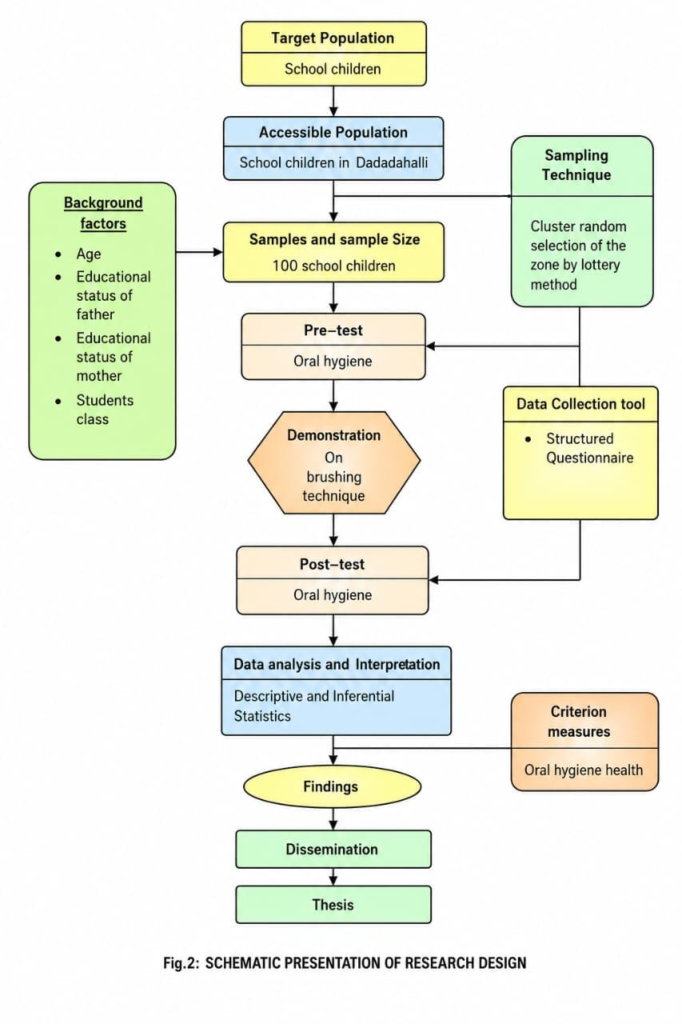
Methods: A quasi-experimental, one-group pre-test post-test design was used. 100 school children from Dadadahalli Government School were selected by cluster random sampling. Health education on brushing technique was given. Post-test was done after 15 days.
Results: Mean pre-test knowledge 5.37 ± 1.22 increased to 8.74 ± 0.86. Mean pre-test practice 3.33 ± 0.865 increased to 5.49 ± 0.522. Difference was significant for knowledge [t= -23.06, p<0.001] and practice [t= -19.19, p<0.001].
Conclusion: Health education on brushing technique was effective in improving knowledge and practice of oral health among school children.
Keywords: Oral health, Health education, School children, Knowledge, Practice.
INTRODUCTION:
Dental caries and periodontal disease are widely prevalent in developing countries like India and are preventable by changing behavior. School is the best place to provide dental health education as habits are formed in childhood.
Oral health is an essential component of general health and well-being. Poor oral hygiene in childhood leads to dental caries, gingivitis and affects nutrition, speech and self-esteem. According to WHO, nearly 60-90% of school children worldwide suffer from dental caries.
In India, the prevalence of dental caries among 12-year-old children is reported to be 50-60%. The school environment provides an ideal setting for health promotion activities because children spend most of their time in school and can influence family practices.
Health education is a cost-effective and sustainable approach to improve knowledge and bring behavioral changes. Demonstration of correct brushing technique can significantly improve oral hygiene practices among children. Hence, the present study was undertaken to assess the effectiveness of health education on knowledge and practice of oral health among school children.
CONCEPTUAL FRAMEWORK
The conceptual model provides a certain frame of reference for clinical practice, research and education. They provide for thinking for observations and for interpreting what is seen. They also give direction for relevant questions on phenomena and point out solutions to practical problems.
The present study aims at developing and evaluating a Health Education program on school students of Dadadahalli with a view to enhance their knowledge and practice on oral health. This refers to the prepared health education on oral health to teach the school children’s of Dadadahalli village. Conceptual model of the present study is based on the Van Bertlanffy general system model a guide for development, utilization and evaluation.
A system is a set of integrated, interacting parts that function as a whole. The system can be closed or open in that there is a continuous exchange of matter energy and information. Open system has varying degree of interaction with environment from which the system receives input and gives back output in the form of matter, energy or information. The system returns output to the environment in an altered state, effecting the environment. The feedback is the responses of the system. Feed back may be positive, neutral or negative. System components include Input, Throughput, Output and feed back.
Input: Input is the information needed by the system. Input refers to the school children as a system which has input within the system itself and the environment. In this study it refers to the characteristics of school children such as age, sex, mother education, father education and the preparation of Health education and the pre-test of the knowledge and practice regarding oral health
Throughput: It is action needed to accomplish the desired output. In this study it refers to the Health Education on oral health and interaction between the students and investigator.
Output: The information is continuously processed throughout the system and released as output in an altered state. In the present study output refers to increase in the knowledge and practice scores of school students regarding oral health as measured by the post test.
Feedback The feedback is the ‘environment’ response of the system may be positive, neutral and negative. The output is related to the knowledge and practice of the school children’s regarding oral health. If the score is inadequate, it refers that the throughput has to be re-evaluated and which is not included in the study.
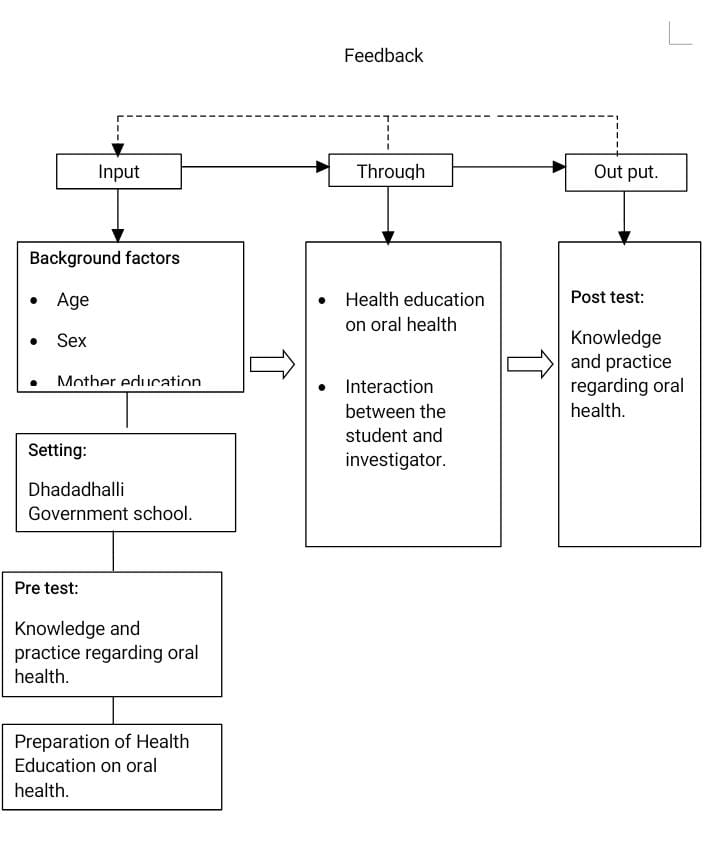
Figure 1: Conceptual Framework based on Van Bertlanffy General System Model.
METHODS:
Design: Quasi-experimental, one-group pre-test post-test.
Setting: Dadadahalli Government School, Mysore.
Sample: 100 school children aged 6-12 years by cluster random sampling.
Procedure: Pre-test → Health education with demonstration → Post-test after 15 days.
Ethics: Permission from Headmistress.
Analysis: SPSS. Paired t-test and linear regression. p<0.05 significant.
Figure 2: Schematic Presentation of Research Design.
RESULTS:
DATA ANALYSIS AND INTERPRETATION:
This chapter deals with the processing and analysis of the data collected in order to outline the purpose of the research plan. In this study data collected from the traffic police are processed and analyzed. G.B Giles defines “in process of analysis, relationships or differences supporting or conflicting with original or new hypotheses should be subjected to statistical tests of significance to determine with what validity data can be said to indicate any conclusion”. Polit and Hungler (2004) define interpretation refers to the process of making sense of the results and of examining the implications of the findings within a broader context .The process of interpretation begins with an attempt to explain the findings, within the context of theoretical framework, prior knowledge in the area and the limitations of the study.
The result was computed using descriptive and inferential statistical methods by using SPSS 11 version. A probability of less than 0.05 was considered to be significant.
THE OBJECTIVES OF THE STUDY:
- To assess the knowledge and practice of Oral Health before and after the Health Education programme regarding Oral Health.
- To associate the knowledge of mean difference score with selected background factor.
- To associate mean difference of practice with selected background factor.
ORGANISATION OF THE RESEARCH FINDINGS:
The findings of the study are organized in terms of the objectives tested. The data are presented under the following headings.
Section I: Data on Background factors.
Section II: Data on dental health before and after teaching on brushing.
Section III: Data on association between selected background factors and mean difference on knowledge and practice in relation to teaching on brushing.
SECTION I: DATA ON BACKGROUND FACTORS OF SCHOOL CHILDREN
Table 1: Frequency and Percentage Distribution of Background Factors.
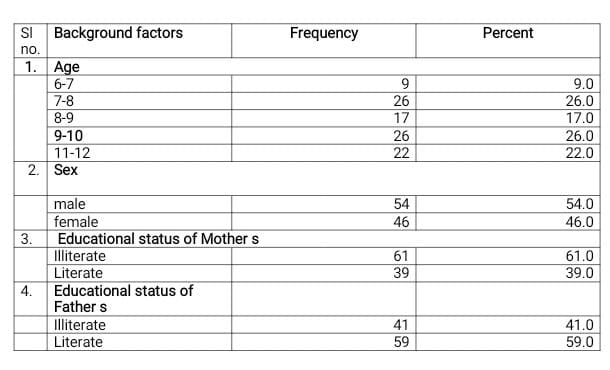
Age 7-8y: 26%, 9-10y: 26%. Male: 54%. Mother illiterate: 61%. Father illiterate: 41%.
SECTION II: DATA ON DENTAL HEALTH BEFORE AND AFTER TEACHING ON BRUSHING.
For the purpose of study the following null hypothesis was stated.
H01 – There will be no significant difference between the pre-test score and post-test score of knowledge and practice in relation to teaching on brushing.
Table 2: Mean, standard deviation, mean difference, t-value regarding pre and post test score of knowledge and practice in relation to teaching on brushing.
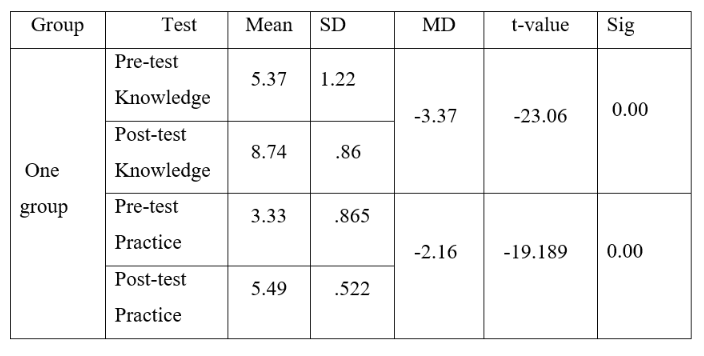
Knowledge: 5.37 to 8.74, t= -23.06, p<0.001
Practice: 3.33 to 5.49, t= -19.19, p<0.001
SECTION III: DATA ON ASSOCIATION BETWEEN SELECTED BACKGROUND FACTORS AND MEAN DIFFERENCE ON KNOWLEDGE IN RELATION TO TEACHING ON BRUSHING.
For the purpose of study, the following null hypothesis was stated.
H 03 : There will be no significant association between the selected background factors and the mean difference on knowledge in relation to teaching on brushing.
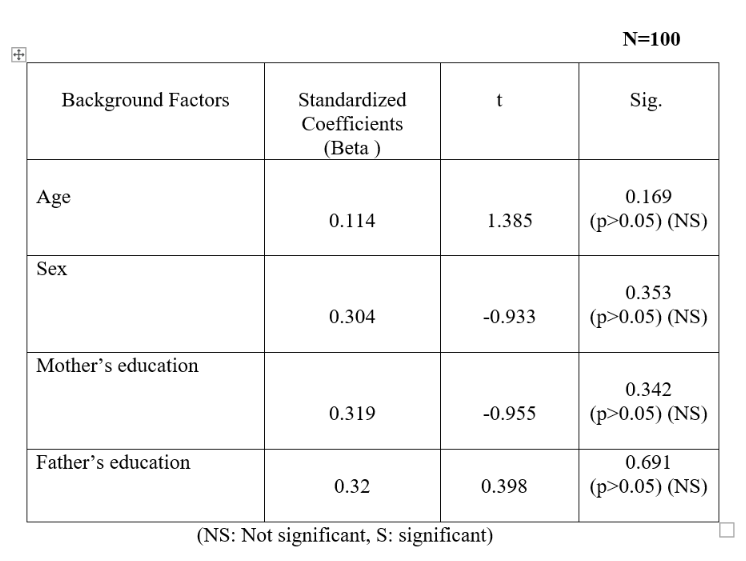
No significant association between background factors and improvement. p>0.05.
DISCUSSION
Health education significantly improved knowledge and practice. Similar results were found in other school-based studies. This shows universal benefit regardless of background factors.[4]
CONCLUSION
Health education on brushing technique is effective. School health programs should include regular dental health education.
REFERENCES
- World Health Organization. Oral Health. Geneva: WHO; 2020.
- Petersen PE. The World Oral Health Report 2003. Community Dent Oral Epidemiol. 2003;31 Suppl 1:3-23.
- Polit DF, Beck CT. Nursing Research. 10th ed. Philadelphia: Wolters Kluwer; 2017.
- Shetty PJ, et al. Effectiveness of oral health education among school children. J Clin Diagn Res. 2016;10(4):ZC46-ZC49.
- Kumar S, et al. Effect of toothbrushing frequency on dental caries. Dent J. 2016;4(4):27.
- Chandrashekar BR, et al. Dental caries among school children of Davangere. J Indian Assoc Public Health Dent. 2010;8(15):6-10.
- Park K. Park’s Textbook of Preventive and Social Medicine. 25th ed. Jabalpur: Banarsidas Bhanot; 2019.